Pin Money: Why the Humble Noticeboard Still Beats the Algorithm
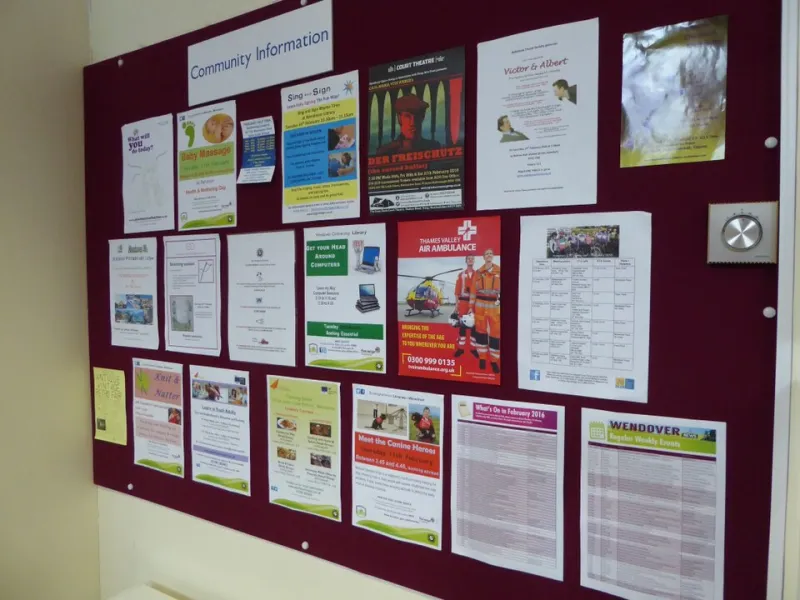
Photo: Libraries Taskforce, CC BY 2.0, via Wikimedia Commons
I have a confession: I love a noticeboard. Not the corporate kind with a laminated mission statement. The real kind: cork, staples, a faded poster for a yoga class that ended in 2023, and a handwritten card offering 'two hens, free to a good home'. The kind you find in a library, a launderette, a post office or the window of a chip shop. The kind that does not ask for your email address.
In 2026, we are told that community is online. And it is, partly. But the physical noticeboard is quietly making a comeback, not as a heritage attraction but as a working tool for people who are tired of the feed.
The last place that does not want your data
A noticeboard is a strange kind of media. It is public, but not broadcast. It is local, but not algorithmic. It is slow, but not dead. You have to leave the house to read it. You have to stand still. You might have to move someone's pram to see the bottom corner. That friction is the point.
I spent a morning in a launderette in south London where the board is maintained by the owner, a woman called Pauline. She has run the place for 19 years. The board is a mess of lost keys, room rentals, guitar lessons and a weekly grief group. 'I don't curate it,' she says. 'I just take the old ones down when they curl up. People need somewhere to put things.'
That is the radical thing about a noticeboard: it is not a platform. Nobody is optimising it. Nobody is tracking clicks. The person who pins up a card for a choir practice is not building a personal brand. They are trying to find three more altos.
What you find when you actually look
The notices themselves are a kind of folk art. There is always a card for a dog walker with a photo of a dog that looks suspiciously like a stock image. There is always a plea for a 'reliable cleaner, no agencies'. There is always a poster for a pub quiz with a prize that turns out to be a meat raffle. And there is always, somewhere, a handwritten note that says 'lost tortoise, please check your garden'.
These are not just jokes. They are the small infrastructure of a neighbourhood. A noticeboard tells you who is selling a pram, who is teaching piano, who is looking for a flatmate, who is organising a street party. It is a search engine for the street.
The people who maintain these boards are the unsung editors of grassroots media. A library assistant in Sheffield keeps a corner for teenagers' zine notices. A postmistress in Norfolk has a strict rule: no political leaflets, but anything for a local group is fine. A chip-shop owner in Cardiff lets kids put up drawings next to the community council minutes. None of them call themselves publishers. They are just holding space.
The new generation is pinning things up
What is changing in 2026 is who is doing the pinning. Younger organisers are rediscovering the board as a complement to their group chats, not a replacement. They put up a QR code next to the handwritten notice. They run a zine launch and ask the café to display a poster. They treat the board as a physical landing page.
That is smart. A poster can be ignored, but it can also be seen by someone who would never have found the event online. A noticeboard is a discovery engine with no cookies. It is also a good filter: if you cannot be bothered to print a poster and ask permission to pin it, maybe your event is not ready for the room.
How to revive one
If your local board is dead, you can probably fix it. Ask the owner if you can take over maintenance. Start with a clear-out. Remove anything more than six weeks old. Buy a box of pins and a roll of blank cards. Put up a sign that says what the board is for. Then use it. Pin up a notice for a seed swap, a repair café, a walking group. Tell other people to do the same. It sounds small because it is small. That is the point.
The noticeboard is not a solution to digital overload. It is a small, analogue counterweight. It is somewhere to put a card when you need a room, a friend, a tortoise or a choir. In 2026, that feels less like nostalgia and more like common sense.