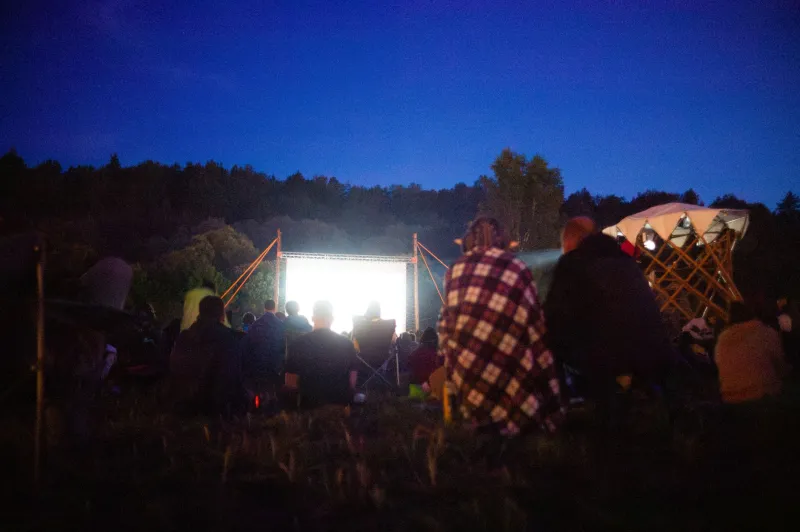
Faders Before Certificates: Inside the Venue-Run Desk Nights Teaching Sound by Doing
Photo: Internet Archive Book Images, No restrictions, via Wikimedia Commons
On the first Tuesday of every month, a volunteer-run arts centre in West Yorkshire opens its doors when there is no show to put on. The bar stays shut. The stage lights are half up. In the corner of the room, beside a radiator that clanks like a distant drum kit, a small group gathers around a mixing desk that has seen better decades.
This is desk night at a venue we will call the Old Baths — a 120-capacity room with a sprung floor, a stubborn heating system and a cupboard full of inherited PA gear. The night is not a formal course. Nobody hands out a certificate. But for a few hours, a handful of teenagers, career-changers and curious volunteers get to do the thing that grassroots venues have always needed and rarely had the budget to teach: mix a live gig.
The cupboard that became a classroom
The Old Baths did not set out to run a training programme. Like many small venues, it inherited equipment when other rooms closed or upgraded. There are two old powered speakers, a mixer with a few scratchy faders, a box of XLR cables that have been labelled and relabelled with gaffer tape, and a tangle of DI boxes that nobody is quite prepared to throw away.
What the venue did not have was money for staff training. When its regular sound engineer moved away in the spring, the committee realised how much knowledge had walked out of the door with them. A paid course was out of reach. A college module was too far away and too long. So the venue tried something simpler: a monthly evening where the gear stays out, the stage stays free and anyone who wants to learn can get their hands on the desk.
It helps that the night is attached to a real event. Local bands are invited to soundcheck in front of the group, then play a short set while learners take turns at the desk under supervision. That means the training is not abstract. There is feedback to chase, a vocalist who cannot hear themselves, a guitar amp that keeps creeping up and a room that behaves differently once it fills with people.
What actually happens on a desk night
By half six, the room is half-lit and half-full. The organiser starts with a tour of the desk: gain, EQ, aux sends, monitor mixes, mute groups and the master fader. Nobody is expected to remember all of it. The point is to make the desk feel less like a spaceship and more like a set of ordinary controls with consequences.
Learners are paired up. One sits at the desk while the other stands on stage with a microphone, swapping positions after each song. They learn how to do a line check without apologising to the whole room. They learn why a monitor mix is not the same as a front-of-house mix. They learn that feedback is not a moral failure, but a signal to look at the gain structure and the microphone position.
The group is mixed. There is a 17-year-old who plays in a band and wants to understand what happens on the other side of the stage. There is a 42-year-old who spent years in an office and is thinking about doing something more useful with her weekends. There is a volunteer who has been selling tickets for a decade and has finally decided to learn what all the cables do.
What they share is not prior knowledge. It is willingness to be in a room where being bad at something is part of the deal. The organiser keeps the language plain. No one is made to feel stupid for asking what a DI box is. The answer is practical: it is the little box that helps a keyboard or a bass get to the desk without a mess.
Why this model is spreading
The Old Baths is not alone. Across the UK, volunteer-run halls, arts centres and pub back rooms are sitting on equipment that is underused and skills that are unevenly shared. The live sector has been talking about a technician shortage for years, but the pipeline into small venues is thin. Formal training is valuable, but it can be expensive, geographically awkward and hard to fit around work or caring responsibilities.
Venue-run desk nights offer something different. They are local, low-cost and rooted in the actual rooms where gigs happen. They also create a route into volunteering that is more structured than being handed a cable and wished good luck. For venues facing tight budgets in 2026, that matters. A trained volunteer can cover a quiet night, support a paid engineer or spot when a problem needs someone more experienced.
The model is not a replacement for proper training in rigging, electrical safety or large-scale sound. A cupboard of mismatched cables will not teach anyone how to design a system for a 500-capacity room. But for the small rooms that make up the grassroots circuit, it can build confidence, vocabulary and a local pool of people who know the venue, the kit and the regular performers.
The limits worth naming
There is a risk in dressing up free labour as training. The Old Baths is careful about this. Learners are not left alone to run a paid gig. They work alongside an experienced volunteer, and the venue is clear that desk night is a learning space, not a staffing solution. The distinction matters. Grassroots venues run on goodwill, but goodwill should not become an excuse for avoiding paid work where it is needed.
There is also a limit to what can be taught in a monthly session. Desk night gives people a start, not a qualification. It cannot cover every acoustic problem or every piece of equipment. It works best when it is honest about that. The organisers point learners towards further training, other venues and local engineers who are willing to mentor. The desk is a doorway, not the whole house.
Still, the atmosphere in the room is not anxious. It is the atmosphere of people working something out together. A fader moves too far and the vocal disappears. Someone laughs. The organiser suggests a different approach. The band on stage waits, adjusts a lead, tries again. By the end of the night, the group has mixed a short set that sounds roughly like a gig, and nobody has been asked to pretend they know more than they do.
What a room can pass on
The most interesting thing about desk night is not the equipment. It is the transfer of knowledge between people who might otherwise never spend an evening in the same room. A retired engineer shows a teenager how to read a signal chain. A career-changer asks the question that everyone else was too embarrassed to ask. A band learns that the person behind the desk is not a gatekeeper but a neighbour.
For a sector facing a skills shortage and a winter of tight budgets, that is worth paying attention to. The answer is not always a new course or a new fund. Sometimes it is a venue that keeps its gear out for one more evening, puts the kettle on and lets people learn by doing. The desk in the cupboard is not just storage. In the right room, it is a way of growing the next person who knows what to do when the vocal disappears.