After the Service, the Screening: Inside Britain's Volunteer-Run Church Hall Cinemas
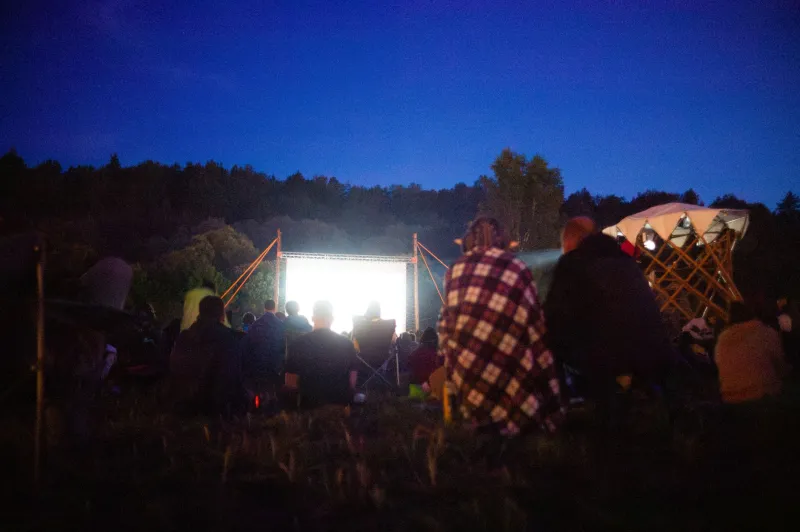
On a Friday night in a hall that smells faintly of floor polish and orange squash, forty people are watching a 1962 black-and-white film on a screen that, half an hour earlier, was a blank wall. The projector is second-hand. The chairs are stacking. The tea urn is already on. This is the church hall cinema, and across Britain it is quietly becoming one of the most dependable rooms in grassroots culture — not because the films are obscure, but because the whole thing is built to be repeated.
The room was never the hard part
The appeal is easy to see. A church hall, scout hut or British Legion back room can usually be hired for somewhere between £20 and £40 a night. There's a kitchen, a loo, parking, and a built-in local audience that already knows where the door is. Compared with a venue that has staff, a bar and a listing fee, the overheads look almost comically low.
The hard part is everything else, and most of it is paperwork. Showing a film to the public is a licensable activity under the Licensing Act 2003, so the first call is to whoever runs the hall: does the existing premises licence cover film exhibition, or will you need a temporary event notice for each screening? Free entry does not get you off the hook — if the public can come in, it counts. On top of that sits the screening licence itself, arranged through an organisation such as Filmbankmedia or the Motion Picture Licensing Company depending on the title. Cinema for All, the charity that has supported community cinemas for decades, is the usual first port of call for volunteers trying to work out which licence covers what. Budget for both lines before you print a single poster.
Lamp hours, lumens and the blackout problem
There is a thriving second-hand projector market, and it is full of traps. The headline number is brightness: somewhere around 3,000 lumens is a sensible floor for a hall where you can't fully kill the lights. But the number that actually matters is lamp hours. A cheap projector with a lamp at 80 per cent of its life is a false economy once you price up a replacement, which can cost more than the unit itself. Native resolution, fan noise and whether it takes HDMI without a nest of adapters are all worth checking before you hand over cash.
Then there is the screen. A pull-down model is the tidy option; a matt white painted wall is the cheap one, provided it isn't gloss and isn't lumpy. Blackout is the recurring headache — church halls tend to have tall windows and summer evenings that refuse to cooperate. Velcroed curtains and a roll of blackout lining have saved more screenings than any amount of AV cleverness.
Sound catches people out next. The built-in speaker on a business projector will not fill a hall, so a powered speaker or a decent soundbar is essentially part of the kit. Check region codes on DVDs (region 2) and Blu-rays (region B), make sure subtitles are switched on by default, and test the whole chain — disc to projector to speaker — an hour before doors, not five minutes before.
The programme is the personality
The clubs that last tend to have a point of view rather than a schedule of whatever was on offer. Archive titles, local documentaries, themed seasons and the occasional oddball double bill all work, partly because they give people a reason to come back next month rather than waiting for a blockbuster. The BFI's Film Audience Network and the regional Film Hubs are worth knowing about for programming ideas, audience research and the occasional bursary.
But the real differentiator is the interval. A film that runs comfortably under two hours, a proper pause with the urn and a plate of something, and twenty minutes of chat afterwards will do more for audience loyalty than any marketing push. Nobody comes for the film alone.
Show me the money
Most halls run on a £5 ticket, a season pass for the regulars, a raffle, a cake table and a bit of goodwill. Local councils sometimes have small grants for community events; Film Hubs occasionally offer support for audience development; and halls will often discount a block booking. Insurance is usually arranged through Cinema for All's scheme, and the per-screening licence fee needs to sit in the budget from day one rather than being discovered in week three. Relying on donations alone is the fastest route to a club that folds after two seasons.
Rotas, risk assessments and the second projectionist
No one warns you about the tea rota. It is infrastructure. So is the person who knows how to work the projector when the regular volunteer has flu. Train a deputy, write the running order down, PAT-test the extension leads, do the risk assessment, keep a step ladder handy and think about a hearing loop if the hall doesn't have one. Children's matinees bring their own safeguarding questions, and a hall full of under-tens needs a different kind of crowd management to a hall full of film buffs.
None of this is glamorous. All of it is what separates a one-off screening from a cinema that the village starts to plan its month around. The multiplex has the screen and the seats. The church hall has the urn, the rota and the forty people who walk home together afterwards — and that, increasingly, is the bit people turn up for.