Names in the Margin: The Guest Books Quietly Archiving Britain's Small Rooms
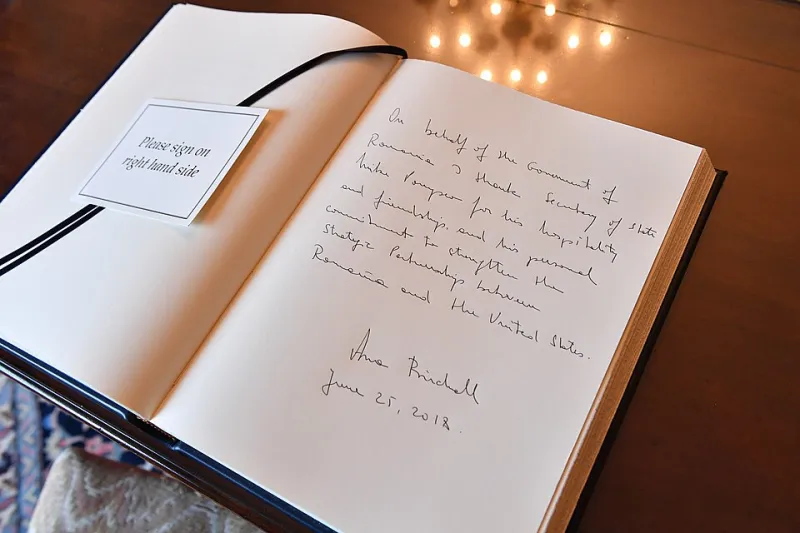
Photo: U.S. Department of State from United States, Public domain, via Wikimedia Commons
The book is usually the least designed thing in the room. A hardbacked notebook from a stationery shop, or a ring binder with a sheet of A4 taped to the front reading VISITORS — PLEASE SIGN. The pen is attached with string, or it was, until someone nicked it. It sits on a trestle table next to the raffle tin and a plate of biscuits that are going soft.
And yet it is, functionally, the archive. Not the press release, not the grant report, not the Facebook event that will vanish the moment the page is quietly retired. The book by the door is the only place where the room records that it was, briefly, full.
The book nobody was asked to make
Almost nobody sets out to create a historical record. A guest book appears for practical reasons: the hall committee wants a headcount for its insurance, the zine fair wants an email list, the gig promoter wants to know how many people actually turned up versus how many said they would. Memory is a side effect.
That side effect is doing a lot of work. In a sector where the paperwork is either absent or written for funders rather than for the people in the room, an informal log becomes evidence. It is the difference between "we think about forty came" and a page with thirty-eight signatures and one drawing of a dog.
What's actually in there, and what isn't
The entries fall into recognisable species. The full name and postcode, written by someone who assumes this is official. The first name only, in a hand that suggests they'd rather not. The single letter. The joke entry. The child's crayon. The person who wrote brilliant night and nothing else, as though the evening were the point rather than the identity.
Read a stack of these and you learn things no survey would tell you. You learn which nights pull from across town and which pull from the same six streets. You learn that the Sunday afternoon events have a completely different crowd from the Friday ones — a fact that never shows up in a ticketing platform's dashboard because most of these events don't sell tickets at all, or sell them on the door, in cash, into a Quality Street tin.
You also learn what's missing. The regulars don't sign. The volunteers don't sign. The people who came in for the second half and left before the lights went up don't sign. Anyone who felt awkward about being asked doesn't sign. The book records attendance the way a photograph records a wedding: selectively, and from one angle.
Consent, kept in biro
There's a quiet ethics to the guest book that most organisers are working out in real time. A signature is not the same as consent to be contacted, and it is certainly not consent to be archived. Since the data protection rules tightened, some halls have started adding a line — signing does not add you to any mailing list — in the same handwriting as everything else, which somehow makes it feel more trustworthy than a privacy notice printed in six-point type.
Others have gone the other way and stopped collecting names entirely, keeping a simple tally on a clipboard. The count survives; the people don't. It's a defensible choice, and it makes the resulting record far less useful to anyone trying to understand who the room actually served.
The middle ground, where most places sit, is messier: a book that exists, that nobody has thought hard about, that will end up in a box in a cupboard and might one day be the only account of a scene that thought it was too small to need one.
The numbers organisers use, and the ones they don't
Ask a promoter how a night went and you'll get a figure. Ask what they did with the book and you'll get a shrug. The book is rarely consulted after the fact, except when someone is writing a funding bid and needs to say something about reach.
That's the odd tension. The most human document in the building gets mined for a number and then put back in the drawer. The drawing of the dog never makes it into the report.
Some organisers have started doing something more deliberate: photographing the pages at the end of each season, keeping a folder, occasionally scanning one into a zine. Not for funders — for themselves. A hall in the Calder Valley has a shoebox going back to the mid-nineties, and the handwriting changes as the committee changes, which is its own kind of history.
An archive with no archivist
What should you do with a guest book? The honest answer is that nobody knows, and the institutions that would know are not usually in the room.
A few sensible habits have emerged by consensus rather than policy. Keep the physical book — paper survives format changes. Note the date on the first page, because an undated guest book is a puzzle rather than a record. Ask before you publish a page; names plus a location is a lot of information in a small town. And when the hall is eventually redecorated and someone suggests binning the old books, put them in a box instead.
What to write next time
There's no wrong way to sign a guest book at a village hall or a zine fair or a gig above a pub. Your name, your initials, a line about the night — all of it counts, in the loosest possible sense of the word count.
But it's worth noticing the book for what it is. Not admin. Not a mailing list in waiting. A small, scruffy, voluntary act of remembering, made by people who had no reason to think anyone would ever look. Which is, when you think about it, how most of grassroots culture gets recorded: accidentally, by whoever happened to be holding the pen.